Light duty towing for cars, pickups, SUVs and vans
Flatbed only. Running or not, keys or no keys. Typical response 30 to 45 minutes.
Flatbed only. Running or not, keys or no keys. Typical response 30 to 45 minutes.
Light duty is the category almost every tow falls into. Your car, your partner’s SUV, the pickup you use for work. Anything up to about the size of a full-size crew cab. If it has four wheels and it is not a commercial box truck, it is light duty, and it is what our flatbeds are built around.
The word “light” is misleading. There is nothing lightweight about a modern SUV, and a three-quarter-ton pickup with a full tank is a serious load. What the category actually describes is a vehicle that fits on a standard flatbed deck and sits inside the truck’s rated capacity. That covers the overwhelming majority of what is on the road around Ann Arbor.
We tow these on flatbeds, every time. No wheel lifts, no dollies.
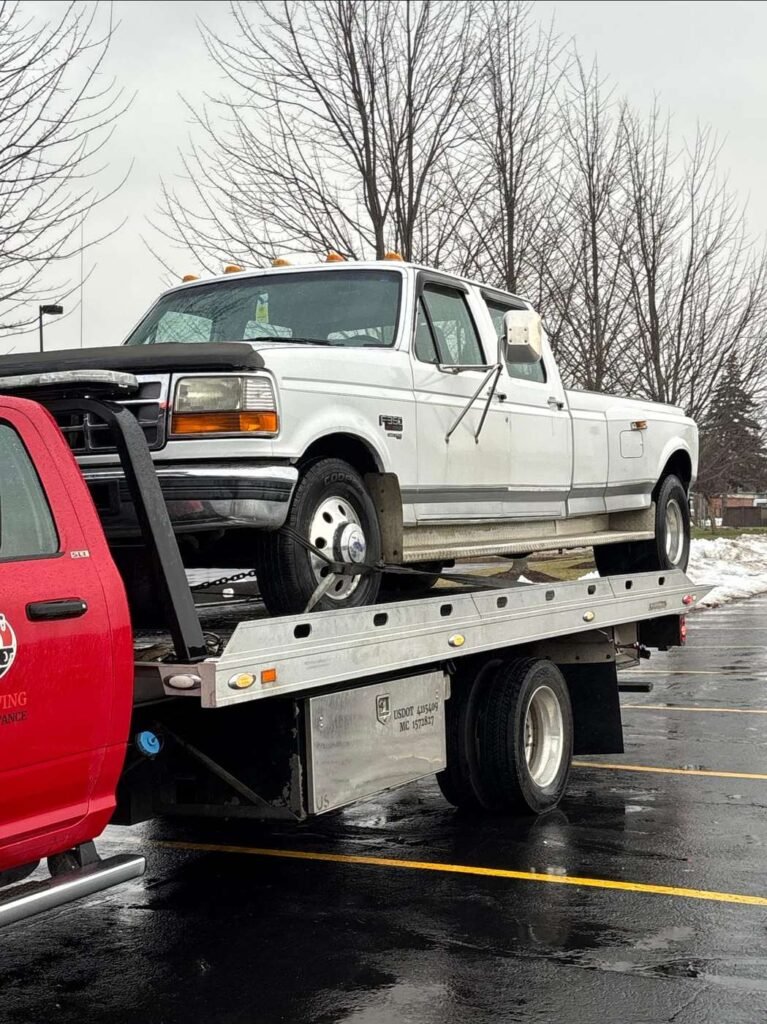
A wheel lift picks up one axle and leaves the other rolling down the road. It is cheaper to run, it is faster to hook, and for some vehicles it is genuinely fine. For a lot of what is on Michigan roads now, it is not. All-wheel drive is the main reason. On most AWD systems, letting two wheels turn while the other two are lifted sends the drivetrain through a rotation it was never designed for. Depending on the vehicle, that ranges from unnecessary wear to a transfer case that needs replacing. Plenty of owners’ manuals say flatbed only, in writing, and plenty of drivers find that out after the fact.
Then there is ground clearance. A car sitting low, either from the factory or because someone lowered it, will scrape its front lip climbing onto a lift. On a flatbed the deck tilts down to the road and the approach angle is far gentler. And there is the simple mechanical case. A wheel that will not turn, a seized brake, a locked steering column, a flat tyre on the axle that is supposed to be rolling. All of these are non-events on a flatbed and all of them are a problem on a lift. The flatbed costs us more to run. We think it is the right call and we do not offer the alternative.
Sedans, hatchbacks and coupes of every size. Crossovers and SUVs, including the large three-row ones. Pickups from a Ranger up to an F-350 or a Ram 3500. Minivans and passenger vans. Small cargo vans like a Transit Connect or a Promaster City. Beyond the obvious, we regularly move vehicles most people assume are a problem:
Cars that will not start, for any reason. Dead battery, dead alternator, failed starter, blown head gasket. A flatbed does not care why it stopped.
Cars with no keys. Repossessions, estate vehicles, a car bought at auction, a set of keys that went missing three owners ago. We winch it on.
Cars that have not moved in years. Flat tyres, seized brakes, rusted-solid rotors, a nest in the engine bay. Very common on restoration and project cars, and something we deal with most weeks.
Cars that have been in a minor collision and are still roughly the right shape but are not safe to drive. If it is a serious crash scene, see accident towing instead. Vehicles going to auction, to a dealership on trade, or between two family driveways.
Everywhere we work, which is roughly a thirty mile radius from Ann Arbor. In practice the highest volume is Ann Arbor and Ypsilanti, along the US-23 and I-94 corridors, and around the retail and commuter traffic in Canton and Plymouth.
Winter changes the mix. A cold snap in January produces a run of cars that will not start, and the calls cluster in residential streets and workplace car parks rather than on the highway. Summer is more breakdowns in motion and more project cars moving as people finally get round to them.
Yes. A flatbed does not need the vehicle to run. We winch it onto the deck, so a dead battery, a failed starter or a seized engine makes no difference to whether we can move it.
That is fine. We tow vehicles with no keys regularly, including auction cars, repossessions and estate vehicles. Without keys we cannot release an electronic parking brake, so tell us on the call and the driver will bring skates or dollies if the wheels will not roll.
Not on a flatbed. All four wheels come off the ground, so nothing turns through the drivetrain. This is why many all-wheel-drive owners’ manuals specify flatbed towing only, and it is why we do not run wheel lifts.
Anything up to roughly a full-size pickup or a large SUV. A Ford F-350 or a Ram 3500 is comfortably within it. Once you get to box trucks, cube vans and sprinters you are into medium duty, which we also handle.
Yes. Flat tyres, missing wheels and seized brakes are all routine on a flatbed. Mention it when you call so the driver arrives with skates if they are needed.
Call and we will give you a price and a realistic time before a truck leaves.
© 2026 Express Towing & Roadside Assistance. All rights reserved.